
COPLANT-Vienna-Kohorte

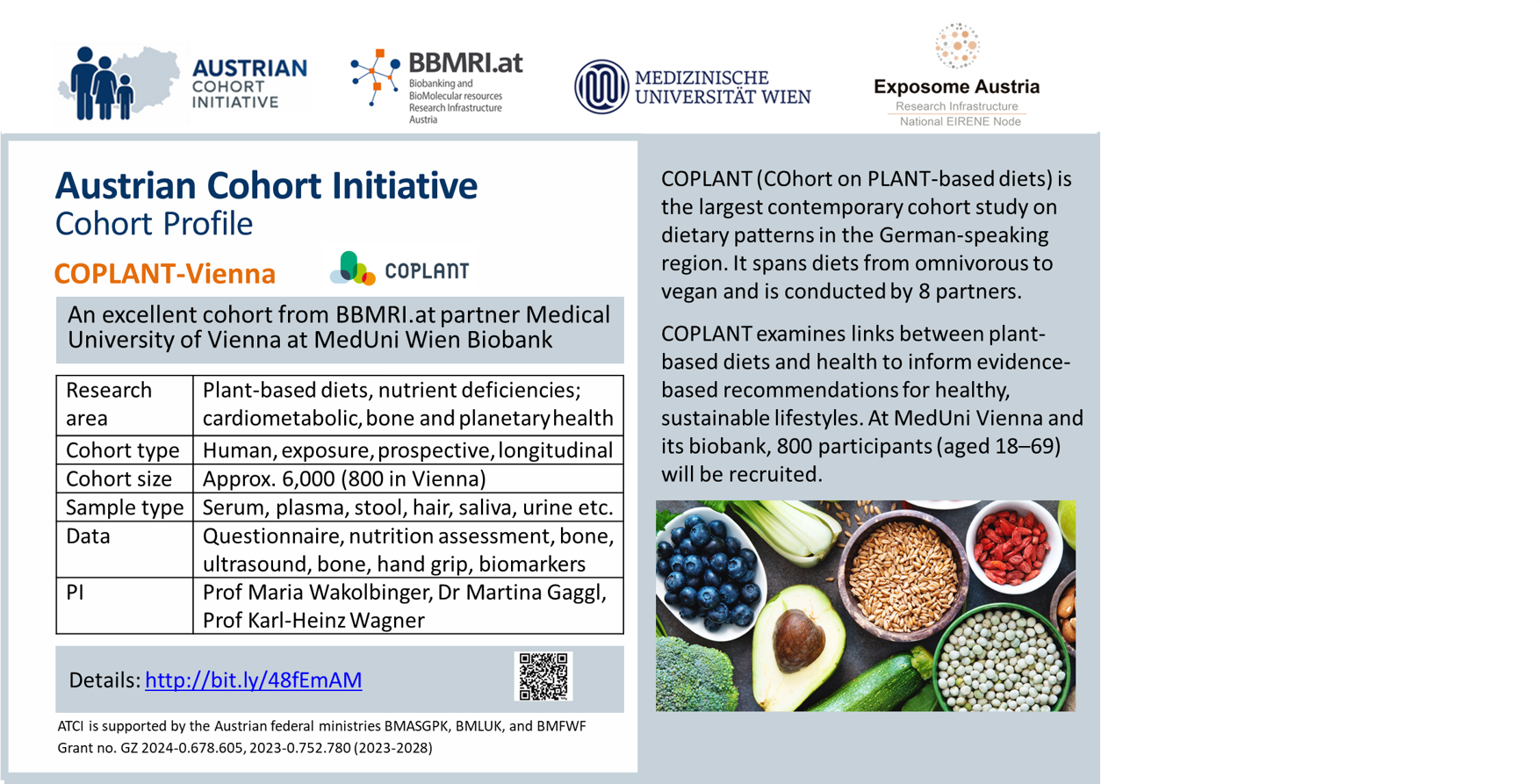
Eine exzellente Kohorte des BBMRI.at Partners Medizinische Universität Wien an der MedUni Wien Biobank

COPLANT steht für COhort on PLANT-based diets. Es handelt sich um die derzeit größte Kohortenstudie im deutschsprachigen Raum, die vier Ernährungsweisen in gleichen Anteilen abbildet – einschließlich pflanzenbasierter Ernährungsformen. Das Projekt wird vom Bundesinstitut für Risikobewertung (BfR) und sieben weiteren Universitäten und Institutionen getragen, darunter die Medizinische Universität Wien in Kooperation mit der Universität Wien.


Ziel der COPLANT-Studie ist es, Datenlücken zu schließen und wissenschaftlich fundierte Ernährungsempfehlungen für einen gesunden und nachhaltigen Lebensstil zu ermöglichen. Von Anfang 2024 bis Ende 2027 werden insgesamt rund 6.000 Teilnehmer*innen rekrutiert – darunter 800 Personen im Alter von 18–69 Jahren in Wien.


Im Fokus der Studie stehen folgende Ernährungsweisen:

  • Omnivor: Mischkost, einschließlich tierischer und pflanzlicher Produkte
  • Pescetarisch: kein Fleisch, aber Fisch
  • Vegetarisch: kein Fleisch oder Fisch, aber Milchprodukte und Eier
  • Vegan: keine tierischen Produkte


Profil der Kohorte (auf Englisch):

Research Area
Plant-based diets, diet quality, nutrient deficiencies, cardio-metabolic health, bone health, planetary health
Cohort Type
Human, exposure cohort, prospective, longitudinal
Cohort Size
800 participants from Austria/Vienna, part of the multi-centre COPLANT cohort (comprising in total approx. 6,000 participants in Germany and Austria and 8 study centers; 30 years of follow-up)
Donors/ Participants
Volunteers sampled from the general population with the ability to provide informed consent and to communicate in German
Age: 18-69 years
Dietary habits:
• 25% omnivorous (mixed diet, including all types of animal and plant products)
• 25% pescatarian (no meat, but fish)
• 25% vegetarian (no meat or fish, but dairy products and eggs)
• 25% vegan (no animal products)
Biological Sample Types (with Storage Condition)
Serum, Plasma, Buffy coats, Spot urine, 24h urine, Stool, Hair, Saliva
Samples stored at -80° C
Associated Data
Questionnaires on socioeconomic status, nutrition, FFQ (food frequency questionnaire), health status, everyday life, lifestyle, medication intake, dietary supplements; Detailed nutritional assessment using 4-days weighed dietary records; BIA (body composition); Waist and hip circumference; Bone quality (ultrasound-based assessment); Hand grip strength; Blood pressure; Ultrasound (e.g., thyroid gland, liver, muscle, kidney, visceral fat, etc.); Broad range of biomarkers
Collection Period
Started 2024 – ongoing (for 30 years)
Informed Consent
Broad constent
Access
Yes; shared resource from 2028 on; academic collaboration only; short written proposal required; access granted by steering committee;
Quality Standards
The biological samples from the Austrian participants are stored at MedUni Wien Biobank which is included in quality management systems according to ISO 9001:2015; the central Biobank is placed at the University of Jena, Germany
Contact
Principle investigators:
• Ap. Prof. Maria Wakolbinger, PhD MSc
maria.wakolbinger@meduniwien.ac.at
• Priv.-Doz. Dr. Martina Gaggl, MD, PhD, MPH
martina.gaggl@meduniwien.ac.at
• Univ.-Prof. Mag. Dr. Karl-Heinz Wagner
karl-heinz.wagner@univie.ac.at

Publications (Scientific)
None yet as only started in 2024
Research projects
None yet as only started in 2024