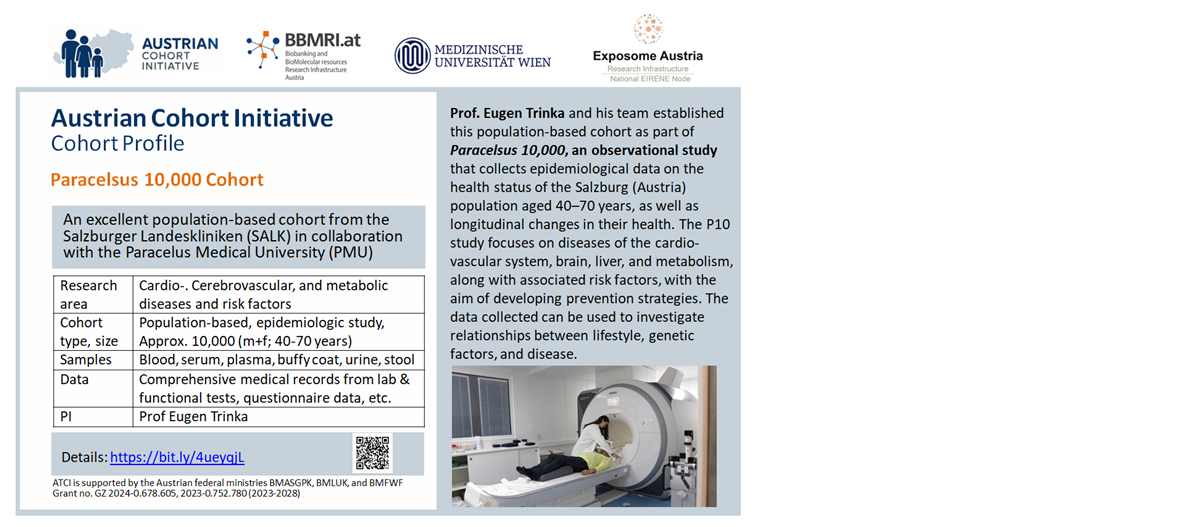


Paracelsus 10,000 Cohort
An excellent population-based collection at Salzburger Landes Kliniken (SALK) in collaboration with the Paracelus Medical University (PMU)
The population-based Paracelsus 10,000 Cohort is part of the Paracelsus epidemiological study on the health of the Salzburg populationincludes approx. 10,000 participants (5,000 male and 5,000 female) aged 40-70 years, recruited from the city of Salzburg (Austria) and its surrounding regions. The participants were randomly selected to assess baseline health status and to investigate longitutinal changes in a prospective study design.
The purpose of this cohort is to address the following study aims:
- To collect robust epidemiological data on the state of health of the Salzburg population
- To investigate the interaction of genetic disposition and lifestyle factors in the development of non-communicable diseases
- To develop targeted prevention strategies for the Salzburg population
- To strengthen the research location Salzburg and Austria
Profile of the cohort:
Research Area
Cardiovascular and cerebrovascular, as well as metabolic diseases and risk factors (life style, SES, genetics).
Cohort Type
Population-based, part of a observational, epidemiologic study
Cohort Size
10,044 participants (baseline), of whom ~3,800 (ongoing follow-up)
Biological Sample Types
(with storage condition)
(with storage condition)
Biological samples: Serum, Plasma, Stool und Urine are stored at -80 °C
80/120 aliquots per person:
• Serum (24 x 0.25 ml)
• Plasma EDTA (24 x 0.25 ml)
• Plasma Citrate (8 x 0.25 ml)
• Plasma Heparin (8 x 0.25 ml)
• Buffy Coat (x 2)
• Whole blood for DNA Isolation (4 x 3 ml)
• Stool
• Urine (8 x 1.0 ml) and stool* (apprx. 50g)
• Oral Glucose Tolerance Test (OGTT)* after 0, 30, 60, 90, 120 minutes 4 x 0,25 ml Plasma EDTA and 4 x 0,25 ml serum
*only in the basic
80/120 aliquots per person:
• Serum (24 x 0.25 ml)
• Plasma EDTA (24 x 0.25 ml)
• Plasma Citrate (8 x 0.25 ml)
• Plasma Heparin (8 x 0.25 ml)
• Buffy Coat (x 2)
• Whole blood for DNA Isolation (4 x 3 ml)
• Stool
• Urine (8 x 1.0 ml) and stool* (apprx. 50g)
• Oral Glucose Tolerance Test (OGTT)* after 0, 30, 60, 90, 120 minutes 4 x 0,25 ml Plasma EDTA and 4 x 0,25 ml serum
*only in the basic
Associated Data
Basis
Investigations:
• Electrocardiogram (ECG)
• Doppler Ultrasound
• Height, weight, BMI
• Blood pressure
• Abdominal girth
• Ultrasound carotides
• Ankle-Brachial Index*
• Body Impedance Analysis (BIA)*
• Spirometry*
• 24- hours blood pressure*
• Coronary Ca- Score*
• DEXA- Scan*
• Fibro Scan liver*
Functional test:
• Hand grip*
• Walking speed
• Acceleration analysis*
• Ergo spirometry*
*only the intensive group
Questionnaires:
• Sociodemographics and occupation
• Lifestyle
• Smoking habits
• Alcohol consumption
• Quality of life (12F)
• Beck’s Depression Inventory (BDI)
• Epworth Sleepiness Scale (ESS)
• Barratt Impulsiveness Scale (BID)
• Environmental medicine
• Back pain (ODQ-D)
• EPIC Physical Activity Questionnaire (EPIC-PAQ)
• Health and family history
• Impingement syndrome
• Coxarthrosis
• Gonarthrosis
• Family medical history
• Medical history questionnaire
• Mediterranean diet
• Menopause
• Dietary questionnaire (EPIC)
• 7-day physical activity questionnaire*
• 7-day dietary questionnaire*
• International Physical Activity Questionnaire (IPAQ)*
Interview:
• Medical history
• Diseases
• Medications
• Family medical history
• Psychological diseases
• Screening questions
• Generalized anxiety disorder
• Bulimia nervosa
• Anorexia nervosa
• Obsessive-compulsive disorder
• Episode of major depressive disorder
• Social phobia
• Agoraphobia
• Manic and hypomanic episodes
• Panic disorder
• Post-traumatic stress disorder
• Salzburg Dementia Test
Follow-up
Investigations
• Electrocardiogram (ECG)
• Doppler Ultrasound
• Height, weight, BMI
• Blood pressure
• Abdominal, Hip upper arm and thigh girth
• Ultrasound Carotides
• Magnetic Resonance Imaging (MRI)*
• Magnetoencephalography (MEG)*
• Consortium to Establish a Registry for Alzheimers’s Disease (CERAD)*
• Hearing test*
Interview:
• Medical history
• Diseases
• Medications
• COVID-19 disease and vaccination
• Migraine questionnaire
Questionnaires:
• Sociodemographics and occupation
• Lifestyle
• Smoking habits
• Alcohol consumption
• Quality of life (12F)
• EPIC Physical Activity Questionnaire (EPIC-PAQ)
• Beck’s Depression Inventory (BDI)
• Epworth Sleepiness Scale (ESS)
• Menopause
• Allergies
• Edinburgh Lifetime Musical Experience Questionnaire (ELMEQ)
• Adult-Self-Report (ASR)*
*only the intensive group
Investigations:
• Electrocardiogram (ECG)
• Doppler Ultrasound
• Height, weight, BMI
• Blood pressure
• Abdominal girth
• Ultrasound carotides
• Ankle-Brachial Index*
• Body Impedance Analysis (BIA)*
• Spirometry*
• 24- hours blood pressure*
• Coronary Ca- Score*
• DEXA- Scan*
• Fibro Scan liver*
Functional test:
• Hand grip*
• Walking speed
• Acceleration analysis*
• Ergo spirometry*
*only the intensive group
Questionnaires:
• Sociodemographics and occupation
• Lifestyle
• Smoking habits
• Alcohol consumption
• Quality of life (12F)
• Beck’s Depression Inventory (BDI)
• Epworth Sleepiness Scale (ESS)
• Barratt Impulsiveness Scale (BID)
• Environmental medicine
• Back pain (ODQ-D)
• EPIC Physical Activity Questionnaire (EPIC-PAQ)
• Health and family history
• Impingement syndrome
• Coxarthrosis
• Gonarthrosis
• Family medical history
• Medical history questionnaire
• Mediterranean diet
• Menopause
• Dietary questionnaire (EPIC)
• 7-day physical activity questionnaire*
• 7-day dietary questionnaire*
• International Physical Activity Questionnaire (IPAQ)*
Interview:
• Medical history
• Diseases
• Medications
• Family medical history
• Psychological diseases
• Screening questions
• Generalized anxiety disorder
• Bulimia nervosa
• Anorexia nervosa
• Obsessive-compulsive disorder
• Episode of major depressive disorder
• Social phobia
• Agoraphobia
• Manic and hypomanic episodes
• Panic disorder
• Post-traumatic stress disorder
• Salzburg Dementia Test
Follow-up
Investigations
• Electrocardiogram (ECG)
• Doppler Ultrasound
• Height, weight, BMI
• Blood pressure
• Abdominal, Hip upper arm and thigh girth
• Ultrasound Carotides
• Magnetic Resonance Imaging (MRI)*
• Magnetoencephalography (MEG)*
• Consortium to Establish a Registry for Alzheimers’s Disease (CERAD)*
• Hearing test*
Interview:
• Medical history
• Diseases
• Medications
• COVID-19 disease and vaccination
• Migraine questionnaire
Questionnaires:
• Sociodemographics and occupation
• Lifestyle
• Smoking habits
• Alcohol consumption
• Quality of life (12F)
• EPIC Physical Activity Questionnaire (EPIC-PAQ)
• Beck’s Depression Inventory (BDI)
• Epworth Sleepiness Scale (ESS)
• Menopause
• Allergies
• Edinburgh Lifetime Musical Experience Questionnaire (ELMEQ)
• Adult-Self-Report (ASR)*
*only the intensive group
Donors Details
Inhabitants of the city of Salzburg, Austria, and the surrounding areas (Elsbethen, Puch, Anif, Hallein, Grödig, Seekirchen, Eugendorf, Wals-Siezenheim) , rnAge range: 40-77 years (baseline) – follow-up ~7 years laterrnGender: ~50% female, ~50% malern20% of participants aged 50–60 years (baseline) underwent deep phenotypingrnrnWithin this population group, participants were randomly selected from the register of residents to assess the baseline health status and to investigate longitutinal changes in a prospective framework.
Collection Period
• First study phase: start 2013 – end 2020
• First follow up: start 2020 – end 2026
• First follow up: start 2020 – end 2026
Informed Consent
Yes – template of the local ethics committee, complemented with study specific content
Access
Yes – collaboration only
Quality Standards
The analysis was conducted in a laboratory that is certified according to ISO 9001:2015 and voluntarily follows the requirements of ISO 15189:2022
Contact
Principle investigator:
PI: Prof. Dr. Mag. Eugen Trinka, FRCP
Management team: Univ.-Prof. Dr. med. Univ. Bernhard Iglseder, Univ.-Prof. Dr. med. Univ. Elmar Aigner, Univ.-Prof. Dr. med. Univ. Bernhard Paulweber
Contact-Email: Andrea Bito (a.bito@salk.at)
PI: Prof. Dr. Mag. Eugen Trinka, FRCP
Management team: Univ.-Prof. Dr. med. Univ. Bernhard Iglseder, Univ.-Prof. Dr. med. Univ. Elmar Aigner, Univ.-Prof. Dr. med. Univ. Bernhard Paulweber
Contact-Email: Andrea Bito (a.bito@salk.at)
Publications (scientific)
See list below
Research projects
No research grants
Publications (scientific):
- Frey, V. N., Langthaler, P., Raphaelis, E., Ring-Dimitriou, S., Kedenko, L., & Aigner, E. (2023). Paracelsus 10,000: an observational cohort study about the health status of the population of Salzburg, Austria. Rationale, objectives and study design. Paracelsus Proc Exp Med.(2023. 1: 1–17. 10.33594/000000600)
- Pühringer, M., Ring-Dimitriou, S., Iglseder, B., Frey, V., Trinka, E., & Paulweber, B. (2022). Sequencing patterns of ventilatory indices in less trained adults. Front Sports Act Living. 2023 Jan 23;4:1066131. doi: 10.3389/fspor.2022.1066131. PMID: 36755562; PMCID: PMC9900118
- Pühringer, M., Ring-Dimitriou, S., Stöggl, T., Iglseder, B., & Paulweber, B. (2020). Differences in the point of optimal ventilatory efficiency and the anaerobic threshold in untrained adults aged 50 to 60 years. Respiratory Physiology & Neurobiology, 282, 103516.
- Pühringer, M., Ring-Dimitriou, S., Stöggl, T., Iglseder, B., & Paulweber, B. (2020). Comparison of visual, automatic and semiautomatic methods to determine ventilatory indices in 50 to 60 years old adults. Journal of Sports Sciences, 38(6), 692-702.
- Lehner C, Spitzer G, Langthaler P, Jakubecova D, Klein B, Weissenbacher N, Wagner A, Gehwolf R, Trinka E, Iglseder B, Paulweber B, Aigner L, Couillard-Després S, Weiss R, Tempfer H, Traweger A. Allergy-induced systemic inflammation impairs tendon quality. EBioMedicine. 2022 Jan;75:103778. doi: 10.1016/j.ebiom.2021.103778. Epub 2022 Jan 7. PMID: 35007819; PMCID: PMC8749446.
- de Sousa DMB, Poupardin R, Villeda SA, Schroer AB, Fröhlich T, Frey V, Staffen W, Mrowetz H, Altendorfer B, Unger MS, Iglseder B, Paulweber B, Trinka E, Cadamuro J, Drerup M, Schallmoser K, Aigner L, Kniewallner KM. The platelet transcriptome and proteome in Alzheimer’s disease and aging: an exploratory cross-sectional study. Front Mol Biosci. 2023 Jun 30;10:1196083. doi: 10.3389/fmolb.2023.1196083. PMID: 37457829; PMCID: PMC10348715.
- Dienhart C, Paulweber B, Frey VN, Iglseder B, Trinka E, Langthaler P, Aigner E, Granitz M, Wernly B. Inverse Association between Educational Status and Coronary CT Calcium Scores: Should We Reflect This in Our ASCVD Risk Assumptions? Int J Environ Res Public Health. 2023 Jun 6;20(12):6065. doi: 10.3390/ijerph20126065. PMID: 37372652; PMCID: PMC10298570.
- Koutny F, Aigner E, Datz C, Gensluckner S, Maieron A, Mega A, Iglseder B, Langthaler P, Frey V, Paulweber B, Trinka E, Wernly B. Relationships between education and non-alcoholic fatty liver disease. Eur J Intern Med. 2023 Dec;118:98-107. doi: 10.1016/j.ejim.2023.07.039. Epub 2023 Aug 3. PMID: 37541922.
- Koutny F, Aigner E, Datz C, Gensluckner S, Maieron A, Mega A, Iglseder B, Langthaler P, Frey V, Paulweber B, Trinka E, Wernly B. Prevalence of Subclinical Cardiovascular Disease in Patients with Non-Alcoholic-Fatty Liver Disease: Analysis of the Paracelsus 10.000 Cohort Study. Med Princ Pract. 2023 Sep 7;32(4-5):272–80. doi: 10.1159/000533909. Epub ahead of print. PMID: 37678174; PMCID: PMC10659702.
- Gensluckner S, Wernly B, Koutny F, Strebinger G, Zandanell S, Stechemesser L, Paulweber B, Iglseder B, Trinka E, Frey V, Langthaler P, Semmler G, Valenti L, Corradini E, Datz C, Aigner E. Prevalence and Characteristics of Metabolic Hyperferritinemia in a Population-Based Central-European Cohort. Biomedicines. 2024 Jan 17;12(1):207. doi: 10.3390/biomedicines12010207. PMID: 38255312; PMCID: PMC10813305.
- Dienhart C, Aigner E, Iglseder B, Frey V, Gostner I, Langthaler P, Paulweber B, Trinka E, Wernly B. Investigating the Added Value of Beck’s Depression Inventory in Atherosclerosis Prediction: Lessons from Paracelsus 10,000. J Clin Med. 2024 Jul 31;13(15):4492. doi: 10.3390/jcm13154492. PMID: 39124759; PMCID: PMC11312733.
- Dienhart C, Gostner I, Frey V, Aigner E, Iglseder B, Langthaler P, Paulweber B, Trinka E, Wernly B. Including educational status may improve cardiovascular risk calculations such as SCORE2. Front Cardiovasc Med. 2024 Oct 11;11:1345277. doi: 10.3389/fcvm.2024.1345277. PMID: 39465138; PMCID: PMC11502382.
- Frey VN, Langthaler PB, Huf MJ, Gruber G, Prinz T, Kedenko L, Iglseder B, Paulweber B, Trinka E. Stress and the City: Mental Health in Urbanized vs. Rural Areas in Salzburg, Austria. Int J Environ Res Public Health. 2024 Oct 31;21(11):1459. doi: 10.3390/ijerph21111459. PMID: 39595726; PMCID: PMC11593727.
- Ausserwinkler M, Gensluckner S, Frey V, Gostner I, Paulweber B, Trinka E, Langthaler P, Datz C, Iglseder B, Thiel J, Neumann HJ, Flamm M, Aigner E, Wernly B. Cerebrovascular risk in rheumatoid arthritis patients: insights from carotid artery atherosclerosis in the Paracelsus 10,000 study. Rheumatol Int. 2025 Jan 18;45(2):33. doi: 10.1007/s00296-024-05781-4. PMID: 39825928; PMCID: PMC11742769.
- Huber-Schoenauer U, Cadamuro J, Kipman U, Stoellinger E, Lichtenauer M, Paar V, Kedenko L, Guggenbichler K, Paulweber B, Pirich C, Salmhofer H. Non-Oxidised Parathyroid Hormone and a Panel of Markers of Calcium-Phosphate Metabolism for Analysis of Secondary Hyperparathyroidism in Selected Patient Groups-A Quality Assurance Project. Int J Mol Sci. 2025 Apr 30;26(9):4279. doi: 10.3390/ijms26094279. PMID: 40362516; PMCID: PMC12071983.
- Bernhard Wernly, Patrick Langthaler, Barbara Fixl, Tobias Kiesslich, Ludmilla Kedenko, Vanessa Frey, Eugen Trinka, Bernhard Iglseder, Maria Flamm, Elmar Aigner, Bernhard Paulweber, Assessing the role of polygenic risk scores in cardiovascular risk prediction: a cross-sectional analysis from the Paracelsus 10 000 cohort, European Journal of Preventive Cardiology, 2025;, zwaf206, https://doi.org/10.1093/eurjpc/zwaf206
- Ausserwinkler M, Flamm M, Gensluckner S, Bogensberger K, Paulweber B, Trinka E, Langthaler P, Datz C, Lindner B, Iglseder B, Aigner E, Wernly B. Exploring the link between socioeconomic factors and rheumatoid arthritis: Insights from a large Austrian study. Ann Epidemiol. 2025 Oct;110:66-71. doi: 10.1016/j.annepidem.2025.07.025. Epub 2025 Jul 22. PMID: 40706886.
- Koutny F, Frey V, Datz C, Gensluckner S, Prosenz J, Langthaler P, Maieron A, Flamm M, Weghuber D, Iglseder B, Trinka E, Paulweber B, Aigner E, Wernly B. Association between depression and metabolic dysfunction-associated steatotic liver disease: a cross-sectional analysis from the paracelsus 10,000 Study. Hepatol Int. 2025 Oct 1. doi: 10.1007/s12072-025-10922-3. Epub ahead of print. PMID: 41032231. PMCID: PMC12923441
- Drach S, Raphaelis E, Langthaler P, Frey V, Ring-Dimitriou S, et al. (2024) Impact of the COVID-19 pandemic on an Austrian population with or without pre-existing health issues. J Neurol Neurol Sci Disord 10(1): 027-038. DOI: 10.17352/jnnsd.000061
- Pühringer M, Ring-Dimitriou S, Iglseder B, Frey V, Trinka E, Paulweber B. Sequencing patterns of ventilatory indices in less trained adults. Front Sports Act Living. 2023 Jan 23;4:1066131. doi: 10.3389/fspor.2022.1066131. PMID: 36755562; PMCID: PMC9900118.
- Lafenthaler, S., Höller, Y., Bergmann, J., Kirschner, M., Frey, V., Rossini, F., Trinka, E., & Staffen, W. (2025). Enhanced clinical evaluation of Alzheimer disease through rapid automatized naming of emotional pictures. Aphasiology, 39, 1–43. doi/full/10.1080/02687038.2025.2520358
- Ausserwinkler, M. (2026). Rheumatische Erkrankungen und Depression. Rheuma Plus. doi.org/10.1007/s12688-025-00925-1
- Ausserwinkler, M., Kronbichler, A., Gensluckner, S., Aberger, S., Paulweber, B., Trinka, E., Langthaler, P., Iglseder, B., Flamm, M., Aigner, E., & Wernly, B. (2026). Association of rheumatoid arthritis with chronic kidney disease. Clinical Kidney Journal, 19(1), Article sfaf391. doi.org/10.1093/ckj/sfaf391
- Bauer, J., Gensluckner, S., Eberhardt, J., Akhgar, A., Datz, C., Iglseder, B., Langthaler, P., Trinka, E., Ausserwinkler, M., Semmler, G., Paulweber, B., Aigner, E., & Wernly, B. (2026). Atherosclerosis burden across subtypes of steatotic liver disease: A European cohort analysis. Nutrition, Metabolism and Cardiovascular Diseases, 104618. doi.org/10.1016/j.numecd.2026.104618
- Ausserwinkler, M., Hueber, A. J., Gensluckner, S., Paulweber, B., Trinka, E., Langthaler, P., … & Wernly, B. (2026). Association Between Rheumatoid Arthritis and Depressive Symptoms: A Population-Based Analysis from the Paracelsus 10,000 Study. Psychiatry Research, 117122. PMID: 41935507; doi: 10.1016/j.psychres.2026.117122