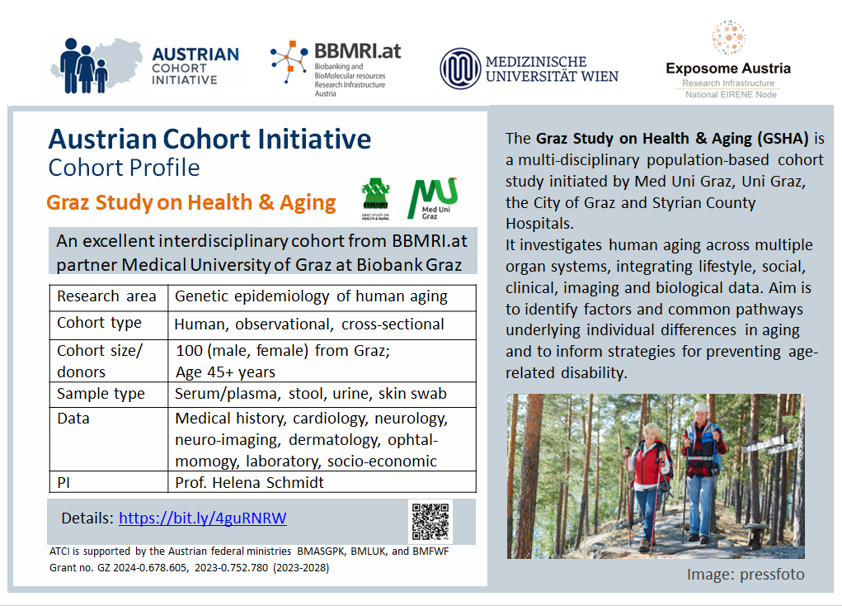


Graz Study on Health & Aging (GSHA)
An excellent cohort from BBMRI.at partner Medical University of Graz
The Graz Study on Health & Aging (GSHA) was initiated in 2010 as a multidisciplinary concerted research effort of the Med Uni Graz, Uni Graz, the City of Graz and and the Styrian County Hospitals. The focus of the study is on human aging, one of the major challenges for medical sciences and health policy in the next decades. The pilot phase was running 2016-17.
Hypotheses
- Human aging is a synchronized manifestation of functional and morphological changes involving all organ systems and in its complexity can only be assessed by a multidisciplinary approach.
- Inter-individual differences in onset and pace of aging are explained by inherited, lifestyle, environmental and social factors
- Identification of common “aging” pathways affecting several or all organ systems allows the identification of potential high-impact targets to prevent age-related disability.
Study design
The GSHA is a community-based cohort study. Suitable persons were randomly selected from the official population register of the city of Graz and invited to participate in the study by sending an invitation card. The response rate was approx. 25%.
Data collection
- The GSHA includes surveys using questionnaires collecting information on socio-demographic data, medication, family history and medical history; life style such as nutrition, physical activity, social behavior; quality of life; reproduction; sleeping habits and personality.
- Clinical correlates of the aging process are assessed by thorough physical examinations of the nervous system, brain, eyes, skin, and cardiovascular system and imaging techniques of the heart, brain and eyes.
- Blood, DNA, RNA, urine and saliva samples of the participants are collected and archived for future use in the Biobank of Graz. Routine laboratory parameters, as also for the hormone status, the composition of the immune system, and genetic parameters such as the length of the telomeres will be measured at the time point of the recruitment.
Profile of the cohort:
Research Area
Genetic epidemiology of human aging
Cohort Type
Human, observational, cross-sectional
Cohort Size
Number of participants: 100
Number of visits: 1 (baseline)
Number of visits: 1 (baseline)
Donor Details
Inclusion criteria:
• Permanent residency of the city of Graz
• Age >=45ys
• Men/women
• Sufficient knowledge of German (for self-assessment) in order to fill out questionnaires and perform cognitive tests
Exclusion criteria:
• Cancer and/or chemotherapy currently or in the last 2ys
• Pregnancy
• Refusing to donate blood sample
• Permanent residency of the city of Graz
• Age >=45ys
• Men/women
• Sufficient knowledge of German (for self-assessment) in order to fill out questionnaires and perform cognitive tests
Exclusion criteria:
• Cancer and/or chemotherapy currently or in the last 2ys
• Pregnancy
• Refusing to donate blood sample
Biological Sample Types
(with Storage Condition)
(with Storage Condition)
• EDTA/citrate/heparin plasma (-80°C)
• Serum (-80°C)
• Stool (-80°C)
• Urine (-80°C)
• Skin swab (-80°C)
• DNA
• RNA
• Serum (-80°C)
• Stool (-80°C)
• Urine (-80°C)
• Skin swab (-80°C)
• DNA
• RNA
Associated Data
Medical history
Risk factors
Medication
Clinical exam
Anthropometry
Cardiology
• Anamnesis
• Cardiologic examination
• EKG
• 24-h blood pressure monitoring
• Echocardiography
• Ergomertry
Neurology
• Anamnesis, Stroke, Dementia
• Neurological Examination
• Cognitive Tests (MMSE, CERAD, NYUPRT)
• Movement ability
• MDS-UPDRS (Parkinson scale)
• BFM-Scale
• Tetras-Scale
• IRLS
• NMS
• UPSIT
• Fullerton Balance scale
• Urogenital Distress Inventory-6 (UDI-6)
• Incontinence Impact Questionnaire (IIQ-7)
Neuroimaging
• Structural 3 T MRI
• DTI, MTI
• iron mapping
• Duplex scanning of carotid artery
• Transcranial Doppler Sonography (TCD)
• Midbrain Sonography
• Functional connectivity
Dermatology
• Fitzpatrick-Typing of skin
• Sun exposion, Sun burn, Sun screen
• Anamnese (polymorphic light eruption)
• Clinical examination
• Eyes and hair colorimetry
• Skin pH (SSC3)
• Lipid/water composition
• Skin elasticity (non-invasive elastometry)
• Hair and skalp status, axillary hair, hair quality and quantity
• Skin surface structure (Microphotography)
• Inner skin structure (in vivo confocale microscopy)
• Nevi (surface microscopy)
• Precancerous skin lesions (total body photography)
Ophtalmology
• Anamnesis
• Clinical eye examination
• Optic disc (HRT3)
• Axial length (IOL Master)
• Refractive status (Accuref-K 9001)
• Visus, Intraocular pressure
• Cornea thickness (Pachmate)
• Fundus
• Retina thickness (Cirrus HD-OCT)
• Retina circulation (RVA)
• Photography
Laboratory
• Hematology: Kl. BB & Diff. BB, mech,
• Serum routine Electrolyte, Kidney; Liver; Glucose, HbA1c IFCC, Thrombotic factors (APTT, Fibrinogen); CRP; Folic acid; Cholesterin, Trigliceride HDL-Chol, VLDL-Chol., LDL-Chol; Total protein; Ferritin, sTrfR; IgG, IgA, IgM; Serum Elfo
• NO-Stress, Oxidative Stress,
• Vitamin status
• Hormon status,
• Blood coagulation
• Iron metabolism
• Leptin, Adiponectin, Adipocin, Resistin
• Urin: test strips; sediments, Ca2+, Ca2+/Creatinin, Phosphate, Creatinin, Albumin
Socio-economic factors/personality
• WHO-Quality of Life 100
• Geriatric depression scale
• NEO Five Factor Inventory
• Sense of Coherence 13
• Self efficacy
• Social support scale
• Social readjustment rating scale
• Consume behaviour
• Art/creativoty
Lifestyle
• smoking: passive/active
• alcohol consumption
• nutrition: FFQ, Food preference, Logbook
• physical activity (actigram, logbook, ergometer) Gripstrength, Static/dynamic balance: MTF platform, Walking speed
Personality
Chronotype
Menopause distress
Genetics
• Family history
• Whole genome sequence
• MethylC-Capture-Sequencing
Risk factors
Medication
Clinical exam
Anthropometry
Cardiology
• Anamnesis
• Cardiologic examination
• EKG
• 24-h blood pressure monitoring
• Echocardiography
• Ergomertry
Neurology
• Anamnesis, Stroke, Dementia
• Neurological Examination
• Cognitive Tests (MMSE, CERAD, NYUPRT)
• Movement ability
• MDS-UPDRS (Parkinson scale)
• BFM-Scale
• Tetras-Scale
• IRLS
• NMS
• UPSIT
• Fullerton Balance scale
• Urogenital Distress Inventory-6 (UDI-6)
• Incontinence Impact Questionnaire (IIQ-7)
Neuroimaging
• Structural 3 T MRI
• DTI, MTI
• iron mapping
• Duplex scanning of carotid artery
• Transcranial Doppler Sonography (TCD)
• Midbrain Sonography
• Functional connectivity
Dermatology
• Fitzpatrick-Typing of skin
• Sun exposion, Sun burn, Sun screen
• Anamnese (polymorphic light eruption)
• Clinical examination
• Eyes and hair colorimetry
• Skin pH (SSC3)
• Lipid/water composition
• Skin elasticity (non-invasive elastometry)
• Hair and skalp status, axillary hair, hair quality and quantity
• Skin surface structure (Microphotography)
• Inner skin structure (in vivo confocale microscopy)
• Nevi (surface microscopy)
• Precancerous skin lesions (total body photography)
Ophtalmology
• Anamnesis
• Clinical eye examination
• Optic disc (HRT3)
• Axial length (IOL Master)
• Refractive status (Accuref-K 9001)
• Visus, Intraocular pressure
• Cornea thickness (Pachmate)
• Fundus
• Retina thickness (Cirrus HD-OCT)
• Retina circulation (RVA)
• Photography
Laboratory
• Hematology: Kl. BB & Diff. BB, mech,
• Serum routine Electrolyte, Kidney; Liver; Glucose, HbA1c IFCC, Thrombotic factors (APTT, Fibrinogen); CRP; Folic acid; Cholesterin, Trigliceride HDL-Chol, VLDL-Chol., LDL-Chol; Total protein; Ferritin, sTrfR; IgG, IgA, IgM; Serum Elfo
• NO-Stress, Oxidative Stress,
• Vitamin status
• Hormon status,
• Blood coagulation
• Iron metabolism
• Leptin, Adiponectin, Adipocin, Resistin
• Urin: test strips; sediments, Ca2+, Ca2+/Creatinin, Phosphate, Creatinin, Albumin
Socio-economic factors/personality
• WHO-Quality of Life 100
• Geriatric depression scale
• NEO Five Factor Inventory
• Sense of Coherence 13
• Self efficacy
• Social support scale
• Social readjustment rating scale
• Consume behaviour
• Art/creativoty
Lifestyle
• smoking: passive/active
• alcohol consumption
• nutrition: FFQ, Food preference, Logbook
• physical activity (actigram, logbook, ergometer) Gripstrength, Static/dynamic balance: MTF platform, Walking speed
Personality
Chronotype
Menopause distress
Genetics
• Family history
• Whole genome sequence
• MethylC-Capture-Sequencing
Collection Period
2016-17 Pilot Study
Informed Consent
• Study specific consents (general & clinic specific)
• Biobank consent
• Biobank consent
Access
Collaboration only
Quality Standards
ISO 9001:2015
ISO 15189
ISO 15189
Contact
Principle investigator:
Helena Schmidt, MD PhD
Professor for Genetic Epidemiology & Susceptibility Diagnostics
Head of Research Unit Genetic Epidemiology
Gottfried Schatz Research Center for Cellular Signaling Metabolism and Aging
Institute for Molecular Biology and Biochemistry
https://www.medunigraz.at/team-helena-schmidt
Tel: +43/316/385-71944
Fax: +43/316/385-79615
Helena Schmidt, MD PhD
Professor for Genetic Epidemiology & Susceptibility Diagnostics
Head of Research Unit Genetic Epidemiology
Gottfried Schatz Research Center for Cellular Signaling Metabolism and Aging
Institute for Molecular Biology and Biochemistry
https://www.medunigraz.at/team-helena-schmidt
Tel: +43/316/385-71944
Fax: +43/316/385-79615
Publications (scientific)
See below
Media articles
See below

Publication list:
- Gampawar P, Saba Y, Werner U, Schmidt R, Müller-Myhsok B, Schmidt H. Evaluation of the Performance of AmpliSeq and SureSelect Exome Sequencing Libraries for Ion Proton. Front Genet. 2019 Sep 25;10:856. doi: 3389/fgene.2019.00856. PMID: 31608108; PMCID: PMC6774276.
- Mishra A, Chauhan G, Violleau MH, Vojinovic D, Jian X, Bis JC, Li S, Saba Y, Grenier-Boley B, Yang Q, Bartz TM, Hofer E, Soumaré A, Peng F, Duperron MG, Foglio M, Mosley TH, Schmidt R, Psaty BM, Launer LJ, Boerwinkle E, Zhu Y, Mazoyer B, Lathrop M, Bellenguez C, Van Duijn CM, Ikram MA, Schmidt H, Longstreth WT, Fornage M, Seshadri S, Joutel A, Tzourio C, Debette S. Association of variants in HTRA1 and NOTCH3 with MRI-defined extremes of cerebral small vessel disease in older subjects. Brain. 2019 Apr 1;142(4):1009-1023. doi: 1093/brain/awz024. PMID: 30859180; PMCID: PMC6439324.
- Gampawar P, Schmidt R, Schmidt H. Leukocyte Telomere Length Is Related to Brain Parenchymal Fraction and Attention/Speed in the Elderly: Results of the Austrian Stroke Prevention Study. Front Psychiatry. 2020 Feb 28;11:100. doi: 3389/fpsyt.2020.00100. PMID: 32180739; PMCID: PMC7059269.
Media articles:
- DerStandard online vom 26.02.2014: Dem Schlüssel zur ewigen Jugend auf der Spur
- Kleine Zeitung vom 27.02.2014: Wie wird man gesund alt?
- LISA online vom 27.02.2014 Grazer Altersforschung: Durch Prävention zur ewigen Jugend
- der Grazer vom 02.03.2014: Grazer Forscher: dem Altern auf der Spur
- orf.at vom 04.03.2014 zum Nachlesen: Studie: Meduni erforscht das Altern
- Kleine Zeitung online vom 04.03.2014: “Graz Study” nimmt Alterungsprozesse unter die Lupe
- Salzburger Nachrichten online vom 04.03.2014: “Graz Study” nimmt Alterungsprozesse unter die Lupe
- Kronen Zeitung online vom 04.03.2014: “Graz Study” – Forscher nehmen Alterungsprozesse unter die Lupe
- APA-Science vom 04.03.2014: “Graz Study” nimmt Alterungsprozesse unter die Lupe
- Tagblatt Wiener Zeitung online vom 04.03.2014: “Graz Study” nimmt Alterungsprozesse unter die Lupe
- Kurier vom 05.03.2014: Medizin-Uni untersucht das Altern mit Studie
- Tiroler Tageszeitung online vom 19.04.2014: Ewig jung: „Graz Study“ nimmt Alterungsprozesse unter die Lupe
- TV Auftritt vom 26.01.2016 zum Nachlesen: Körperliche Fitness hält das Gehirn jung
- TV Auftritt vom 27.01.2016 zum Nachlesen: Fitness hält auch das Gehirn gesund